Epoxy vs. Polyaspartic vs. Polyurea: Which Garage Floor Coating Is Best in Louisville?
Search for the best garage floor coating and three names appear again and again: epoxy, polyaspartic, and polyurea. One contractor may call epoxy outdated. Another may say it is the best base coat. A third may recommend an all-polyurea system.
These claims can make a simple floor project feel complicated. The better answer is not based on a product label alone. It depends on the concrete, the space, the application process, the expected traffic, and the way each layer works with the next.
The Short Answer for Epoxy vs Polyaspartic Louisville Projects
For many Louisville garages, a layered system can provide a useful balance of adhesion, appearance, and durability. That system may include properly prepared concrete, a resin base or build layer, decorative flake, and a UV-resistant protective topcoat.
A polyaspartic floor is especially attractive when fast curing and UV resistance matter. Sika describes polyaspartic flooring materials as fast-curing, UV-resistant, and hard-wearing. Some Sika products are also marketed as topcoats over flake-broadcast systems.
Still, material selection cannot correct poor surface preparation. A strong coating applied over weak, dirty, damp, or poorly profiled concrete may fail. The complete system and the installation process deserve more attention than a bold sales claim.

A chemistry comparison is useful, but the full floor system matters more than one product name.
What Is Epoxy?
Epoxy is a thermosetting resin used in industrial and decorative flooring. When correctly mixed and installed, an epoxy floor can bond well to prepared concrete and create a smooth, seamless surface.
It is commonly selected for its build thickness, chemical resistance, decorative flexibility, and relatively long working time. That longer application window can help an installer manage color, flakes, metallic movement, and other design details.
Epoxy strengths
Excellent adhesion when correctly installed
Build thickness and a seamless finish
Chemical resistance
Many color and decorative options
Useful working time during application
Epoxy considerations
Some formulas may discolor with prolonged UV exposure
Cure time may be longer than fast-cure systems
Slab moisture can affect the result
Performance depends on preparation and formulation
Epoxy is often used in primers, body coats, metallic floors, and decorative systems. In a garage, its slower cure may be a limitation when a homeowner wants the area returned to service quickly. That does not make epoxy a poor choice. It explains why hybrid systems combine epoxy or polyurea in lower layers with a polyaspartic clear coat.

Epoxy can provide build and decorative versatility when the formula suits the project.
What Is Polyaspartic?
Polyaspartic belongs to the polyurea family. In garage flooring, it is valued for rapid cure, faster return to service, strong UV resistance, abrasion resistance, chemical resistance, and clear topcoat performance.
A polyaspartic floor coating can be useful near a garage door where sunlight reaches the surface. It can also help when the homeowner wants a shorter installation schedule. However, fast application leaves less room for mistakes. Temperature, mixing, timing, and crew experience all matter.
Sika’s current polyaspartic floor-coating literature highlights quick cure, UV resistance, chemical resistance, and use in garage or vehicle environments. These traits help explain why polyaspartic is often used as the protective clear coat above decorative flake.
Factor | Epoxy | Polyaspartic | Polyurea |
Typical strength | Build, adhesion, working time | UV resistance and clear protection | Fast cure and flexibility |
Common position | Primer, base coat, body coat, metallic finish | Protective topcoat | Base or build layer |
Main planning issue | Cure time and sunlight exposure | Short working time | Formulation and installation quality |
What Is Polyurea?
Polyurea describes a broad family of fast-reacting coating materials. It is often valued for rapid curing, flexibility, impact resistance, and the ability to return an area to service quickly.
Some garage systems use a polyurea base layer beneath decorative flake and a polyaspartic clear topcoat. This design can combine fast installation with a UV-resistant finish.
However, “polyurea” alone does not prove that a system is good. Formulation, concrete condition, surface preparation, application conditions, and installation quality still influence the result. Ask which layer uses polyurea, what bonds to the slab, and what protects the completed floor.
Need help comparing system layers?
A Louisville garage may need a different base coat and topcoat combination than a basement or decorative interior. Discuss the concrete and intended use before choosing chemistry.
Is Polyaspartic Always Better Than Epoxy?
No. Marketing often turns a complex decision into a simple contest. The best choice depends on the slab, exposure, working time, temperature, intended use, and system design.
A metallic decorative interior may benefit from epoxy's working characteristics.
A garage receiving sunlight near the door may benefit from a UV-resistant polyaspartic topcoat.
A facility that cannot be out of service for several days may prioritize fast-cure chemistry.
A moisture-prone slab may require specific primers or mitigation before the decorative system.
These examples show why a polyaspartic epoxy floor may contain more than one resin type. The goal is not to select the loudest label. The goal is to match each material to the layer and condition where it performs best.

A complete system may use different materials in different layers.
What Matters More Than the Product Label?
Surface preparation
ICRI publishes concrete surface preparation standards because coatings need suitable mechanical bonding conditions. Mechanical preparation can remove weak surface material, certain contaminants, and incompatible coatings. It also creates the profile required by the selected system.
That is why “What grinder do you use?” may be a more useful contractor question than “Is this epoxy?” A clean, profiled surface gives the coating a better opportunity to bond.

Mechanical grinding helps establish the surface needed for a reliable bond.
Concrete moisture
Concrete moisture must be evaluated before application. ASTM notes that excessive slab moisture can contribute to coating and flooring failures. A contractor should explain whether moisture testing or mitigation is needed for the project.
Crack repair
Cracks do not disappear simply because resin covers them. They should be evaluated and repaired as appropriate before the decorative system is installed. The repair method depends on the crack, movement, location, and condition of the slab.
The protective topcoat
The visible top layer takes daily abuse from tires, grit, tools, water, cleaners, oils, and sunlight near the garage opening. The topcoat should be selected for that exposure. A decorative floor is not complete simply because the color and flake look attractive.
Why Do Homeowners Hear Conflicting Advice?
Companies often sell the system they know best. That naturally affects how they describe alternatives. Homeowners comparing quotes may see several different systems presented as “the best,” even when each system uses a different base, topcoat, cure schedule, and preparation process.
Compare actual specifications instead of repeating brand marketing. Ask about the layer touching the concrete, the layer holding the flake, the final coat, the preparation method, and the expected return-to-service time.
Useful comparison points
Preparation equipment and surface profile
Moisture evaluation and crack treatment
Base coat and decorative layer
Topcoat chemistry and UV resistance
Claims to examine carefully
“Best” without project details
Strength claims without test information
Price quotes with no layer description
Warranty language that lacks exclusions
Ask These Questions Before Hiring a Louisville Coating Company
Clear answers can reveal more than a claim such as “ours is four times stronger.” Use this checklist during an estimate:
How will my concrete be prepared?
Will you test or evaluate moisture?
How will existing cracks be treated?
What chemistry touches the concrete?
What layer holds the decorative flake?
What is the topcoat?
Is the topcoat UV resistant?
How long before foot traffic?
How long before vehicle traffic?
What does your warranty specifically cover?

A site review helps connect material selection to real slab conditions.
What Is Best for a Louisville Garage?
Many residential garages in Jefferson, Oldham, and Shelby counties need to handle vehicle traffic, warm tires, rain moisture, seasonal temperature changes, cleaning chemicals, occasional sunlight, tools, and storage equipment.
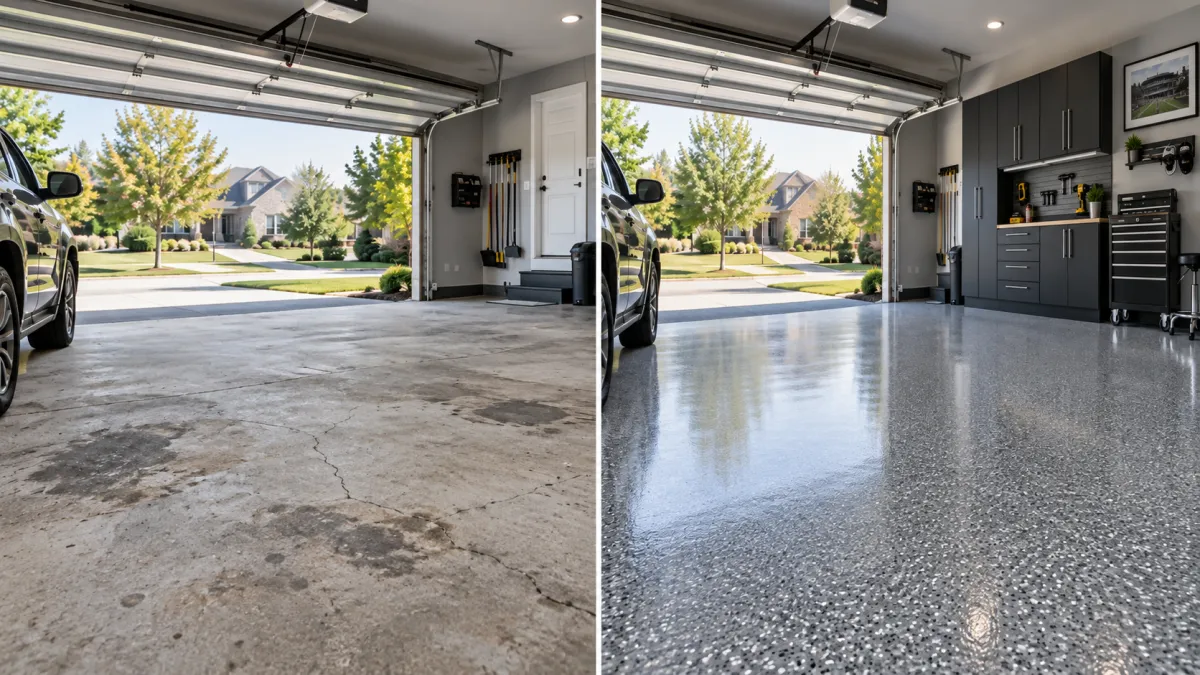
For those reasons, a decorative flake system with an appropriate high-performance topcoat is a popular configuration. It can offer a practical finish while allowing the installer to design the lower layers around the slab and schedule.
Not every garage should receive precisely the same system. A three-car garage in Indian Hills used primarily for vehicles may have different priorities from a workshop in Jeffersontown or a show garage in Norton Commons. The right choice depends on use, exposure, condition, finish, and the homeowner’s desired downtime.

A finished flake floor can balance appearance and everyday garage use.
Basements, Metallic Floors, and the Final Recommendation
What about basements?
Basements usually have less UV exposure, so sunlight may be less important than moisture. An installer should evaluate the slab before recommending a system. Moisture conditions, vapor movement, cracks, and intended use can change the application plan.
What about metallic flooring?
Metallic epoxy is fundamentally different from a full-flake garage floor. It is selected largely for aesthetics and controlled decorative movement. Epoxy’s working characteristics can make it well suited to artistic metallic installations, where timing and design control affect the finish.
Don’t buy chemistry—buy a complete system
The better question is not, “Should I buy epoxy or polyaspartic?” Ask, “What flooring system is appropriate for my slab and the way I use this space?”
The answer should reflect actual concrete conditions, preparation, intended use, layer design, temperature, application timing, and topcoat selection. A professionally installed system can be a sensible investment, but material names alone cannot guarantee the result.
Plan the right Louisville garage floor system
502 Epoxy installs epoxy, flake, polyaspartic/polyurea, and decorative flooring systems throughout East Louisville. Discuss your concrete, preferred finish, traffic needs, and project timing before selecting a coating.
Contact 502 Epoxy at: (502) 308-4272; visit www.502epoxy.com
