Why Garage Floor Epoxy Peels: 7 Causes Louisville Homeowners Should Know
Few things are more frustrating than paying for a new garage floor and then seeing it peel near the tires, bubble in small spots, or separate from the concrete. Many homeowners blame the epoxy right away. Yet the real reason may be moisture, oil, poor surface preparation, damaged concrete, or the wrong coating system.
This guide explains why epoxy floor peels, what the damage may look like, and when a professional review makes sense.
Quick answer: why epoxy floor peels
An epoxy floor peels when the coating does not form a lasting bond with the concrete below it. The bond can fail because the slab was not prepared well, moisture moved through the floor, oil remained in the pores, or the product was applied in poor conditions.
Peeling may also follow cracks, spalling, unsuitable products, or repeated exposure to hot tires. The visible problem is often only the final sign of a deeper issue.
Important: A small loose spot and widespread delamination do not have the same solution. The repair plan depends on how far the failure has spread.
What the leading pages do well
The ranking pages from Everlast Concrete Flooring, Pour La Epoxy, and Garage Floor Crew all address a high-intent problem. Their readers are not casually browsing design ideas. They want to understand a failed floor and decide whether to repair it, replace it, or contact a contractor.
Page type | Primary goal | Audience | Best CTA direction |
Repair guide | Inform and generate service leads | Warm homeowners and property owners | Request an evaluation |
Delamination guide | Explain causes and solutions | Warm prospects comparing options | Discuss repair or replacement |
Garage-floor explainer | Answer a practical homeowner question | B2C readers with visible damage | Call or review installation services |
The common opportunity is a calm, specific CTA. A reader needs confidence that the contractor will inspect the concrete rather than cover the problem with another layer.
Not sure what caused the failure?
Call to discuss the peeling, bubbles, cracks, or tire-lifted spots before choosing a repair method.
7 reasons a garage epoxy floor fails
Most coating problems come from the interaction between the concrete, the product, and the installation conditions. These seven causes can overlap.
1. The concrete was not properly prepared
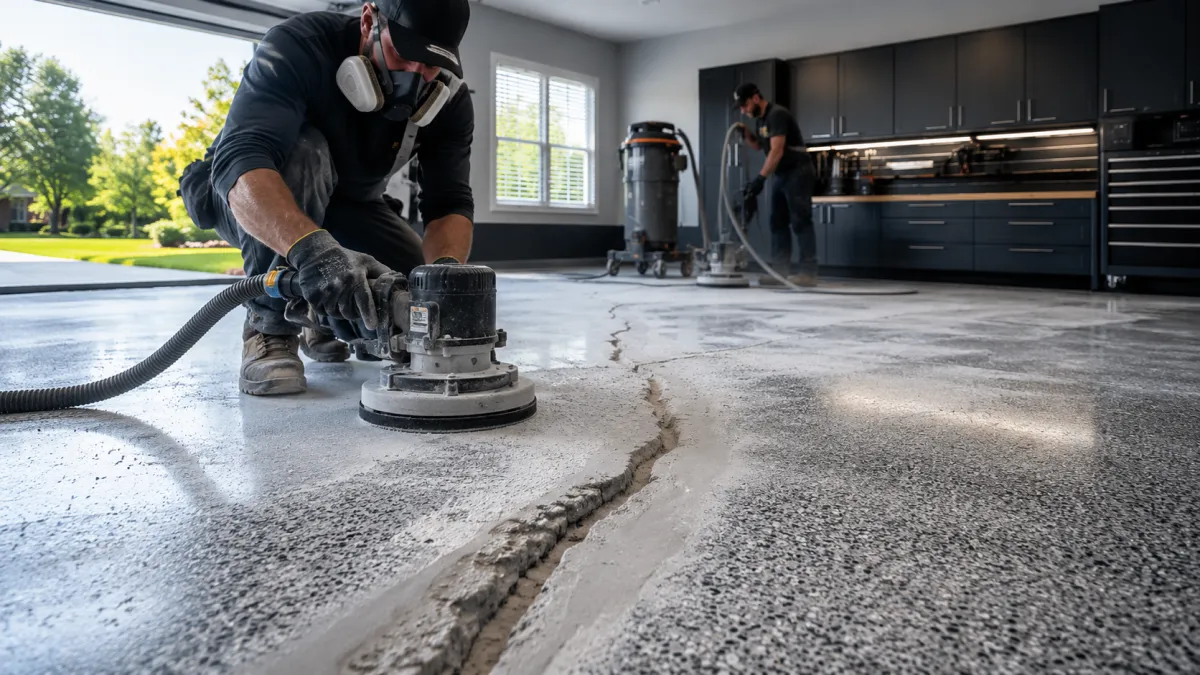
This is one of the most common reasons for peeling epoxy. Concrete can look smooth and clean while still holding weak cement paste, sealers, curing compounds, paint, oil, or an old coating.
A new resin layer needs a sound surface with the right profile. If prep is rushed, the coating may bond to a weak top layer instead of the stronger concrete below. That weak layer can release later.
ICRI provides a surface-preparation framework for matching the surface profile to coating requirements. Mechanical grinding is one common method because it can remove weak material and improve the bond area.
2. Moisture is pushing through the slab
Concrete is porous. Moisture can move through it even when the floor looks dry. This matters in basements and in some ground-level slabs, especially where drainage or soil conditions keep the slab damp.
ASTM’s concrete-floor relative humidity standard notes that excessive moisture can contribute to coating failures such as debonding. Moisture testing should happen before installation, not after bubbles appear.
3. Oil contamination remains in the concrete
Garage floors may absorb motor oil, transmission fluid, grease, silicone, tire products, and automotive chemicals. Wiping the visible stain does not always remove what entered the pores.
Contaminated spots may need added cleaning, grinding, or treatment. If oil remains, the resin may not wet the surface or bond correctly.
4. The wrong coating was used for the environment
Not every product labeled “garage floor epoxy” is designed for the same exposure. A garage floor may face sunlight, hot tires, chemical spills, standing water, abrasion, and winter road residue.
The base, body coat, and topcoat should be selected for those conditions. Certain polyaspartic topcoats offer fast curing, UV resistance, and resistance to tire marking. That does not make polyaspartic the best choice for every floor. The full system and slab conditions still matter.
5. The coating was applied outside proper conditions
Resin chemistry is sensitive to temperature, humidity, slab temperature, dew point, and recoat windows. The correct limits depend on the product.
Applying a layer too quickly or ignoring the manufacturer’s instructions can weaken the coating. Professional installation involves more than rolling resin across concrete.
6. Cracks and damaged concrete were not handled correctly
Floor coating is not structural magic. If the slab is badly cracked, unstable, or spalled, a resin layer will not remove the underlying problem.
Damaged areas should be evaluated and repaired before decorative layers are installed. Control joints and moving cracks also need treatment suited to the particular floor.
7. Hot tires expose weak adhesion
Hot tire pickup is a common garage-floor concern. A tire warms while driving, then cools after the vehicle is parked. Repeated cycles can expose weak adhesion or unsuitable chemistry.
A properly specified system and strong surface preparation can reduce the risk. However, hot tires may reveal a bond problem that already existed.
Why peeling frequently begins near the garage entrance
The garage-door area faces several stresses at once. It may receive sunlight, moisture, temperature changes, tire traffic, grit, and dirt. Water can enter beneath the door, while road residue and sand collect along the edge.
That combination makes the entrance one of the first places where a weak installation may show itself. Look closely at the edges, tire paths, and transition between indoor and outdoor surfaces.

How to inspect the problem before choosing a fix
Start by noting where the coating failed. Is the damage limited to tire paths, edges, oil spots, or several large areas? Does the coating lift in sheets, crack, blister, or look like small bubbles?
Do not keep scraping if the concrete underneath is crumbling. Also avoid sealing visible moisture under a new layer. Photos can help a contractor understand the pattern before an on-site visit.
A repair plan should address the cause, not only the visible spot. Ask what will happen to the remaining coating and whether the slab needs testing.
Can a peeling epoxy floor be repaired?
Sometimes. A small isolated defect may be repairable if the surrounding coating is sound and the concrete is stable. The loose material must be removed, the area prepared, and the repair product matched to the existing system.
If adhesion is failing throughout the slab, patching individual areas may only delay the larger problem. A professional evaluation may show that the old coating should be removed and the floor mechanically prepared again.
The right fix also depends on moisture, contamination, cracks, cure history, and the type of resin already installed.
Get a practical repair opinion
A floor evaluation can help determine whether isolated repair, full removal, or new preparation is the sensible next step.
Review 502 Epoxy servicesCall/text now
How do you avoid peeling before installation?
The best time to prevent coating failure is before installation starts. Ask the contractor to explain each part of the process in plain language.
How will the concrete be inspected?
What preparation method and grinding equipment will be used?
How will cracks and damaged areas be repaired?
Will moisture be evaluated?
How will oil and other contamination be removed?
What resin system, primer, base, body coat, and topcoat are planned?
How long is the cure time before walking and parking on the floor?
If the answer about surface preparation is vague, keep asking. A clear process is more useful than a large color chart or a dramatic warranty claim.

What should prepared concrete look like?
The appearance depends on the coating system and preparation method. Professional grinding generally removes the smooth top layer and leaves a more open, uniformly prepared surface.
The goal is not to make the slab attractive. The goal is to make it suitable for adhesion. A prepared floor may look dull, slightly textured, and different from untreated concrete.
Preparation should also remove weak material and expose areas that need repair. A clean-looking slab is not automatically a ready slab.

Does acid etching work?
Acid etching is a recognized preparation technique for certain applications. It can change the surface profile when used correctly and safely.
Mechanical preparation often gives installers greater control over removing coatings, contaminants, and weak surface material. The correct method should match the coating manufacturer’s requirements and the condition of the concrete.
Homeowners should ask whether etching is enough for an existing painted, oily, or previously coated floor. In some cases, more complete mechanical preparation is needed.

Is peeling covered under warranty?
Warranty wording matters. Do not only ask, “Do you offer a lifetime warranty?” Ask, “What happens if the coating loses adhesion?”
Is labor included?
Is material included?
Is hot tire lifting included?
Is moisture-related failure excluded?
Is crack movement excluded?
Is the warranty transferable?
A shorter warranty with clear terms may be more valuable than a dramatic lifetime claim with many exclusions. Ask for the terms in writing before work begins.

Louisville homeowners: focus on the slab first
Beautiful flakes and gloss are what homeowners see after the job. The concrete underneath determines whether the floor has a strong foundation.
502 Epoxy's concrete-preparation service includes inspection, mechanical preparation and repair prior to coating installation. If you are concerned about cracks, an existing failed coating, or questionable concrete, inspect the slab before choosing colors.
502 Epoxy serves East Louisville, Prospect, Anchorage, Jeffersontown, Middletown, Norton Commons, Indian Hills, Crestwood, La Grange, St. Matthews, Lyndon, and surrounding communities.
Discuss your Louisville garage floor
Call or text for a preparation-focused conversation about peeling, moisture, cracks, oil spots, or a new epoxy garage floor.
Call/text: (502) 308-4272Visit 502epoxy.com

Visual guide to peeling and preparation


What to do next if your floor is peeling
Do not assume every peeling epoxy floor needs the same fix. Isolated damage may need a targeted repair, while widespread failure may call for removal and renewed preparation. Moisture, oil, cracks, and installation conditions should be part of the review.
An on-site professional evaluation is appropriate when the failure is widespread, moisture-related, or connected to damaged concrete. Focus on the slab first, ask direct questions, and choose a coating system that fits the garage environment.
